
The Loudest Voice in the Room
"And the LORD God took the man, and put him into the garden of Eden to dress it and to keep it."
— Genesis 2:15 (KJV)
"And after the earthquake a fire; but the LORD was not in the fire: and after the fire a still small voice."
— 1 Kings 19:12 (KJV)
I was watching a video on Numbers 13 this week, and it started me thinking about the voices we hear whenever God speaks. I thought there were two. God's, and everything else. Then this morning it came to me that there are three.
The first is God's own. The second is the one that started talking in the Garden. And the third is the one we'd rather not own. It's ours.
God Spoke First
Before there was any other voice in the world, there was God's. And the first thing He said to man was a job and a warning.
"And the LORD God took the man, and put him into the garden of Eden to dress it and to keep it" (Genesis 2:15). The word for "keep" is shamar. It means to guard, to watch over, to keep something safe. Adam wasn't just the gardener. He was the one standing watch.
Then God told him, "Of every tree of the garden thou mayest freely eat: But of the tree of the knowledge of good and evil, thou shalt not eat of it: for in the day that thou eatest thereof thou shalt surely die" (2:16–17).
Look at how generous that is. Every tree, freely. One tree, not. And even the "not" was there to protect him.
God's voice always comes first. Every other voice in this post is answering Him.
Then the Serpent
The second voice turned up in the same Garden, and its very first words were about what God had said. "Yea, hath God said, Ye shall not eat of every tree of the garden?" (Genesis 3:1).
It never starts by contradicting God. It starts by wondering out loud what He really meant. And notice it twists the generous part. God said every tree but one. The serpent asks if it was no trees at all.
Then it takes what God said and moves one small word. "Ye shall not surely die" (3:4). God had said they would surely die. The serpent just put "not" in front of it.
The second voice has nothing of its own to say. It can only answer God. That's why it always comes second. And Paul warned that it hasn't changed its methods: "I fear, lest by any means, as the serpent beguiled Eve through his subtilty, so your minds should be corrupted from the simplicity that is in Christ" (2 Corinthians 11:3).
The serpent has never had an original word.
He just keeps putting "not" in front of God's.
Peter Heard Both
Peter shows us how close together these two voices can be.
Jesus asks His disciples, "But whom say ye that I am?" Peter answers, "Thou art the Christ, the Son of the living God." And Jesus tells him, "Blessed art thou, Simon Barjona: for flesh and blood hath not revealed it unto thee, but my Father which is in heaven" (Matthew 16:15–17).
That was the first voice. The Father spoke, and Peter heard Him.
A few verses later, Jesus says He must go to Jerusalem, suffer, be killed, and be raised the third day. Peter takes Him aside and rebukes Him. "Be it far from thee, Lord: this shall not be unto thee" (16:22).
There's that word again. Not.
And Jesus turns and says, "Get thee behind me, Satan: thou art an offence unto me: for thou savourest not the things that be of God, but those that be of men" (16:23).
Same man. Same mouth. Same love for Jesus. One minute he's speaking for the Father, and a few verses later Jesus is calling him Satan. And the second voice didn't sound wicked. It sounded like a friend who wanted Jesus safe.
Forward or Back
That brings us to Numbers 13. Twelve men walked the land of Canaan for forty days and came back carrying a cluster of grapes so big it took two men and a pole (13:23).
Caleb said, "Let us go up at once, and possess it; for we are well able to overcome it" (13:30). In Hebrew he doubles the words: yakol nukal, "being able, we are able."
The other ten answered, "We be not able" (13:31). Lo nukal. The same word Caleb used, with "not" in front of it.
The ten weren't lying about the giants. The sons of Anak really were there. The walls really were high. They just left God out of the decision.
I once spent a whole morning on the beach telling myself there were no fish on that stretch of coast. The man twenty yards down pulled in three. Same water. Different report.
And listen to what was really behind it. "Wherefore hath the LORD brought us unto this land, to fall by the sword, that our wives and our children should be a prey? were it not better for us to return into Egypt?" (14:3).
That's self-preservation. And underneath self-preservation is fear. The whole nation caught it. "The people wept that night" (14:1), and by morning they were talking about choosing a captain to take them back to Egypt (14:4).
Then Joshua and Caleb said the opposite. "Only rebel not ye against the LORD, neither fear ye the people of the land; for they are bread for us: their defence is departed from them, and the LORD is with us: fear them not" (14:9).
Fear them not. That's God's voice. All through Scripture He keeps saying it. Fear not, Abram. Fear not, Daniel. Fear not, Mary. The fear that sends us back to Egypt doesn't come from Him. "For God hath not given us the spirit of fear; but of power, and of love, and of a sound mind" (2 Timothy 1:7).
There's a right fear, the fear of the Lord, and it makes us bold. The fear of the giants is a different thing altogether. It's the old serpent's "not," dressed up as common sense.
The ten had two roads in front of them.
Forward with God, or back to Egypt with their fear.
The Third Voice
But notice something about Kadesh. There's no serpent there. Nobody had to whisper to the ten. By then they could say "not" all by themselves.
That's the third voice. It's our own.
Go back to the Garden and look closely at Genesis 3. The serpent speaks twice, and then he goes quiet. "And when the woman saw that the tree was good for food, and that it was pleasant to the eyes, and a tree to be desired to make one wise, she took of the fruit thereof, and did eat" (3:6).
The serpent didn't say any of that. She saw it. Something in her finished the sentence for him. And it's been finishing his sentences ever since.
Our own voice is the one that says, I've earned this. I deserve this. I need to look after myself first. It sounds reasonable. It sounds responsible. It can even sound righteous.
Jesus told a story about a man who talked to himself like that. His barns were full, and he said, "Soul, thou hast much goods laid up for many years; take thine ease, eat, drink, and be merry" (Luke 12:19). Nobody tempted him. There was no serpent in the barn. He was having the whole conversation on his own.
And God said, "Thou fool" (12:20).
The loudest voice in the room is usually our own.
It doesn't need the devil to tell it what it deserves.
Three Voices and a Television
Say you hear about a family whose home has burned down in the middle of winter. Everything's gone. They've got nowhere to go and nothing but the clothes they were standing in.
The same week, the television you've been wanting all year goes on sale for Christmas.
Now listen. All three voices are in the room.
The first one is quiet. It's the knowing that came to you when you first heard about that family, and hasn't gone away since. "But whoso hath this world's good, and seeth his brother have need, and shutteth up his bowels of compassion from him, how dwelleth the love of God in him?" (1 John 3:17).
The second voice does what it always does. It asks a question. Did God really say that? Are you sure that was Him and not just you feeling guilty? Somebody else will help them. The church will look after it.
And then your own voice joins in, and it doesn't need the serpent's help. I've worked hard all year. I deserve this. Money's tight. I need to look after my own family first.
There's nothing wrong with owning a television. God isn't against you having one. The question isn't the television. It's which voice decided where the money went.
The Still Small Voice
When God met Elijah on Horeb, there was a great wind, then an earthquake, then a fire, and "the LORD was not" in any of them. "And after the fire a still small voice" (1 Kings 19:12). The Hebrew is qol demamah daqqah, "a sound of thin silence."
And when that voice spoke, it asked Elijah a question. "What doest thou here, Elijah?" (19:13).
That's how God speaks to us most days. Not over the top of the other voices. Underneath them. The serpent was loud enough to start a conversation in the Garden. The ten were loud enough to make a nation weep all night. Our own voice is loud enough to drown out a family standing in the ashes. God could drown every one of them out if He chose to. He doesn't.
He knocks. "Behold, I stand at the door, and knock: if any man hear my voice, and open the door, I will come in to him" (Revelation 3:20). He doesn't kick the door in.
Moses said it on the edge of the same land the ten were too afraid to enter. "I have set before you life and death, blessing and cursing: therefore choose life" (Deuteronomy 30:19).
When God called the boy Samuel in the night, Samuel didn't know His voice yet. He mistook it for an old man's three times. God just kept calling, "as at other times, Samuel, Samuel." And when Samuel finally answered, he said, "Speak; for thy servant heareth" (1 Samuel 3:10).
God won't drown out the other voices.
But He will always give you the choice.
Three Voices, One Choice
So here's where it all comes together.
God spoke first, and He always will. Even His "not" in the Garden was a fence around a gift. Every tree but one.
The serpent has never had a word of his own. All he can do is take God's "not" and make us question it. Hath God said? Is He holding out on you? Has He really got a plan for you? And once the question is planted, he goes quiet and stirs up something that was already in us. Our own sense of what we're owed.
That's when our own voice takes over. It sounds like Peter protecting a friend. It sounds like ten sensible men protecting their families. It sounds like, "I've worked hard all year. Didn't I earn this?" Every one of those has a "not" tucked inside it. Not now. Not able. Not my problem.
But there's one more "not" in Scripture, and it answers all the others. In another garden, on the night before the cross, Jesus felt everything the ten felt at Kadesh. He was "in all points tempted like as we are, yet without sin" (Hebrews 4:15). He prayed, "O my Father, if it be possible, let this cup pass from me: nevertheless not as I will, but as thou wilt" (Matthew 26:39).
In Eden, the serpent put "not" in front of God's word, and man took it. In Gethsemane, Jesus put "not" in front of His own will.
That's the choice in front of us every time God speaks. Not God's "not" questioned. Not our own "not" excused. The "not" Jesus prayed. Not my will, but Thine.
In Eden, man took the serpent's "not."
In Gethsemane, Jesus prayed His own. Which "not" will you pray?
For This Week
Write it down in the morning. Write down one thing God has said to you, a promise or a verse you're standing on. At the end of the day, look back. Where did a "not" show up?
Ask whose voice it was. When a thought pushes back against something God said, stop and ask where it came from. Is it questioning what God said, the way the serpent did? Is it fear, pointing you back to Egypt? Or is it your own voice, saying "I deserve this"? Naming it takes some of the volume out of it.
Read Genesis 2 and 3, then Numbers 13 and 14. Notice who speaks first each time, and who answers.
Give the small voice some quiet. Turn something off for ten minutes a day. It's hard to hear a whisper over a television.
Going Deeper
For a group, or on your own with a notebook, take these slowly.
- God's first words to Adam were a job (keep the Garden) and a warning. How does knowing God spoke first change how you hear the other voices?
- The serpent's first words were a question: "Yea, hath God said?" Where do you hear that question in your own life?
- Peter spoke for the Father and then, a few verses later, Jesus called him Satan. Why do you think the second voice sounded so much like love?
- The ten said, "were it not better for us to return into Egypt?" Where is fear dressing itself up as common sense in your life?
- In Genesis 3:6 the serpent goes quiet and Eve's own eyes take over. Where does your own voice finish what temptation starts?
- Think of the last time you sensed God asking you to give or to help someone. What did each of the three voices say? Which one won?
- Samuel said, "Speak; for thy servant heareth." What would it look like to say that to God this week, and mean it?
A Prayer
Father, You spoke first, and You're still speaking. Forgive me for the times I've let the serpent's question stand, for the times I've let fear send me back towards Egypt, and for the far more times I didn't need either of them, when my own voice said "I deserve this." Give me Caleb's courage to go forward. Hush the noise in me. Set my mind on the things that be of God, not the things that be of men. Not my will, but Thine. Speak, Lord; for Your servant heareth. In Jesus' name, amen.
"Only he who believes is obedient, and only he who is obedient believes."
– Dietrich Bonhoeffer, The Cost of Discipleship
"The man who comes to a right belief about God is relieved of ten thousand temporal problems."
– A. W. Tozer, The Knowledge of the Holy
i-CH always
Read the others
Swift to Hear
I Heard You. So Why Didn't You Move?
The Father's Voice
When Eyes Lift Up
The Lord Came to His Temple
The books
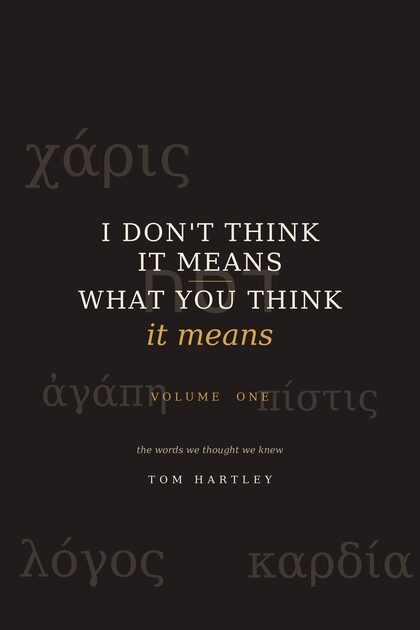
I Don't Think It Means What You Think It Means
Volume One · The words we thought we knew

Ordering in New Zealand? Buy from the shop
Keep Reading