Swift to Hear
It’s Not About Being a Good Listener
Wherefore, my beloved brethren, let every man be swift to hear, slow to speak, slow to wrath.
— James 1:19
And other sheep I have, which are not of this fold: them also I must bring, and they shall hear my voice; and there shall be one fold, and one shepherd.
— John 10:16
You’ve seen this verse on a fridge magnet. Probably next to the one that says God gave you two ears and one mouth for a reason.
Swift to hear, slow to speak. Most of us know it as a communication tip. Put the phone down. Look your wife in the eye. Let the other person finish their sentence before you jump in. It turns up at marriage seminars and leadership courses, and it’s good advice. Most of us could use it.
But that’s not what James is on about. Not first.
And when you see what he actually means, it opens up a story that runs right through the New Testament, from twelve tribes all the way to you.
Watch the “Wherefore”
When you see a wherefore, it’s worth asking what it’s there for. So look at the verse just before it: “Of his own will begat he us with the word of truth, that we should be a kind of firstfruits of his creatures” (James 1:18).
James isn’t talking about your neighbour’s story or your boss’s instructions. He’s talking about the WORD, the word of truth that gave you new life. THAT’S what you’re to be swift to hear.
Now keep reading, a couple of verses on: “But be ye doers of the word, and not hearers only, deceiving your own selves” (James 1:22).
See it now? Swift to hear means quick to let God’s word in. Slow to speak means slow to argue back at it. Slow to wrath means not getting your back up when it pokes at something you’d rather it left alone.
And then the punch: be a doer, not a hearer only. James says the hearer-only is like a man who looks in the mirror, walks off, and forgets what he looks like.
You can be the best listener in your whole church, great eye contact, never interrupts, everybody’s favourite person to talk to, and still be a hearer only. That’s the bit the fridge magnet leaves out.
Is the fridge magnet wrong? No. James has plenty to say about the tongue in chapter 3. Being a good listener to people matters. But it’s the small reading. The big reading is about how quickly you let GOD land.
Written to the Twelve Tribes
Now look at who James was writing to: “to the twelve tribes which are scattered abroad” (James 1:1).
Jewish believers, scattered across the Roman world. People who had grown up saying the Shema every morning and every night: “Hear, O Israel.”
In Hebrew, shema means hear AND obey. If you heard God and didn’t move, you hadn’t heard Him. So when James says “swift to hear”, his readers would have heard the Shema humming underneath it. He wasn’t teaching them anything new. He was reminding them of the oldest thing they knew.
He even has a go at people who know it and don’t live it: “Thou believest that there is one God; thou doest well: the devils also believe, and tremble” (James 2:19). The demons know the words off by heart. They just never HEARD them. Nothing in them moves toward God.
The Door Swings Open
The same James who wrote to the twelve tribes is the man who stood up in Jerusalem when the church had to decide what to do about the Gentiles.
It started with a Roman soldier called Cornelius. He got his whole household together and said to Peter, “Now therefore are we all here present before God, to hear all things that are commanded thee of God” (Acts 10:33). A Roman, talking like an Israelite. Here to hear, and to do. And while Peter was still speaking, the Holy Ghost fell on everyone listening.
So when the leaders met, James got up and said the Gentiles were in. The word that started as Israel’s family word was now for everybody.
Jesus had said it first: “And other sheep I have, which are not of this fold: them also I must bring, and they shall hear my voice; and there shall be one fold, and one shepherd” (John 10:16). Other sheep. And what will they do? They’ll HEAR.
He even acted it out. In Mark 7 He went into Gentile country, and they brought Him a deaf man. Jesus put His fingers in the man’s ears and said one word: “Ephphatha, that is, Be opened” (Mark 7:34). Gentile country. Deaf ears. Opened. You couldn’t paint it clearer.
And right at the end of the Bible, Jesus speaks to seven churches, Jews and Gentiles mixed together, and finishes every letter the same way: “He that hath an ear, let him hear what the Spirit saith unto the churches” (Revelation 2:7).
It started as “Hear, O Israel.” It finishes as “He that hath an ear.”
Anybody. Everybody. If you’ve got an ear, this is your word now.
So, Are You Swift?
Which brings it home to you and me. If you’re not Jewish, and most of us reading this aren’t, you’re one of the other sheep. This word is yours.
And with it comes James’s question. When God speaks, through His Word, through a sermon, through that nudge you’ve been ignoring for a fortnight, how quickly do you let it in?
Or are you quick to explain it away? Quick to argue? Quick to get prickly? Quick to nod and walk off from the mirror?
Swift to hear means God doesn’t have to say it twice. You let it land. And you move.
Try it this week. Next time God puts His finger on something, don’t argue. Don’t debate. Just say what Samuel said: “Speak; for thy servant heareth.” And then do the thing.
I wrote about shema itself in a chapter called “The Word That Asks for Everything,” in Volume One of I Don’t Think It Means What You Think It Means. If this post got you thinking, that’s where the story begins.
A Prayer
Lord Jesus, thank You that I’m one of Your other sheep. Thank You for bringing me into a word that was never meant to stay with one people. Open my ears the way You opened that deaf man’s. Make me swift to hear You, slow to argue, slow to bristle. Let Your word land in me and take root, and don’t let me walk away from the mirror unchanged. Speak, Lord. I’m listening, and I’ll move. Amen.
“Just as love to God begins with listening to His Word, so the beginning of love for the brethren is learning to listen to them.”
– Dietrich Bonhoeffer
“God is speaking. Not God spoke, but God is speaking.”
– A. W. Tozer
i-CH always
The books
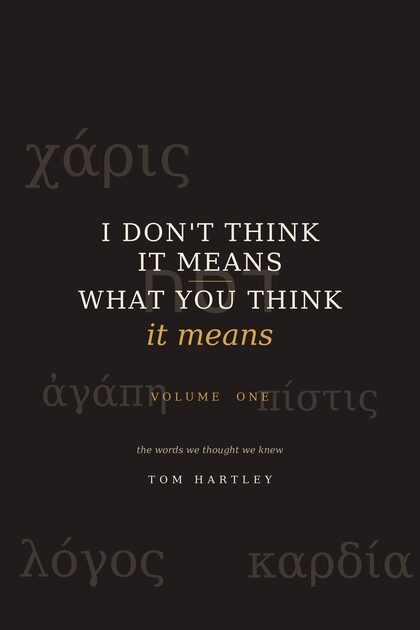
I Don’t Think It Means What You Think It Means
Volume One · The words we thought we knew