I Heard You. So Why Didn’t You Move?
What God means when He says “Hear”
“Hear, O Israel: The LORD our God is one LORD.”
— Deuteronomy 6:4
“For they being ignorant of God’s righteousness, and going about to establish their own righteousness, have not submitted themselves unto the righteousness of God.”
— Romans 10:3
Every parent has had this conversation.
“Did you hear me?”
“Yes.”
“Then why are your shoes still in the hallway?”
The kid isn’t lying. The words went in. They just didn’t go anywhere. And every parent on the planet knows that wasn’t really hearing. That was noise passing through.
God thinks exactly like that parent. He always has.
Hearing IS Doing
The Old Testament word for hear is shema. It’s the first word of the most famous verse in the Jewish faith: “Hear, O Israel.”
Hebrew doesn’t have a separate word for obey. It doesn’t need one. When the Bible wants to say somebody obeyed God, it just says they HEARD Him.
When God says to Abraham, “because thou hast obeyed my voice”, that’s shema. When Samuel tells King Saul, “to obey is better than sacrifice”, that’s shema again. To hear and to obey were the same thing. If you heard God and did nothing about it, you hadn’t heard Him. Simple as that.
The New Testament kept the idea. The word it uses for obey is made of two little words stuck together: under and hear. To obey is to HEAR UNDER. To listen like someone standing under the person speaking, ready to move. “Children, obey your parents”: hear under them. Even the wind and the sea obeyed Jesus. Even the weather knew how to hear its Maker.
Hearing It Sideways
So what’s disobeying?
Paul says “by one man’s disobedience many were made sinners” (Romans 5:19). The word he uses for Adam’s disobedience means hearing it SIDEWAYS. Hearing it alongside something else.
Adam didn’t miss what God said. He knew exactly what God said. He just heard it next to another voice, and went with the other voice.
I’ve watched it happen on the river. I can show a friend precisely where the trout are sitting, under the willow on the far bank. He hears every word. He even nods. Then he walks thirty metres upstream and casts there, because he’s “got a feeling.” He wasn’t deaf. He heard me alongside his own opinion, and his opinion won.
He didn’t ignore me because he couldn’t hear. He ignored me because he was sure he was right.
And that’s the root of it.
The Root Is Self-Righteousness
We like to think disobedience is mostly weakness. We meant to. We got busy. We forgot. Sometimes that’s true.
But underneath most of our not-hearing is something uglier. We’ve decided we know better than God. Our way is the right way. Our judgment is the one we trust. That’s self-righteousness, and it doesn’t need to look proud to be there. It just needs to quietly win the argument.
Paul puts it in one sentence about his own people: “For they being ignorant of God’s righteousness, and going about to establish their own righteousness, have not submitted themselves unto the righteousness of God” (Romans 10:3).
Then, a few verses later: “But they have not all obeyed the gospel” (10:16).
Same chapter. Same people. Their own righteousness on one side. Not hearing on the other. Paul doesn’t treat them as two different problems. They’re one problem. When you’re busy building your own righteousness, you can’t hear God’s.
And notice who Paul is talking about. Not pagans. Not people who’d never heard of God. Israel. The people who said “Hear, O Israel” every morning and every night. He even says “they have a zeal of God” (10:2). They were serious, religious, Bible-reading people. And they weren’t hearing.
A Problem for God’s People
This was never somebody else’s problem. Right through the Bible, it’s the people OF God who struggle with it most.
God said to Israel, “Obey my voice, and I will be your God, and ye shall be my people.” And then: “But they hearkened not, nor inclined their ear, but walked in the counsels and in the imagination of their evil heart, and went backward, and not forward” (Jeremiah 7:23–24).
The counsels of their own heart. Their own opinion. Thirty metres upstream.
Isaiah didn’t point the finger at anybody else. He put himself right in it: “But we are all as an unclean thing, and all our righteousnesses are as filthy rags” (Isaiah 64:6). We. Our. Not their sins. Our righteousnesses. The good things we were proud of.
Jesus told a parable “unto certain which trusted in themselves that they were righteous” (Luke 18:9). Not to the tax collectors. To the people in the front row.
And it didn’t stop when the church started. Jesus says to the church at Laodicea, “thou sayest, I am rich, and increased with goods, and have need of nothing” (Revelation 3:17). A church that thought it was fine. And Jesus is standing outside its door: “Behold, I stand at the door, and knock: if any man hear my voice…” (3:20).
Jesus, outside His own church, knocking, waiting for somebody to hear.
That’s us too. The church is very good at hearing sermons and very bad at hearing God, and most of the time it’s because we already think we’re doing all right.
King Saul and the Sheep
The clearest picture of all is King Saul.
God told him plainly what to do with the Amalekites and everything they had. Saul did most of it. He kept the best of the sheep and the oxen. Then he went to meet Samuel with a big smile: “Blessed be thou of the LORD: I have performed the commandment of the LORD” (1 Samuel 15:13).
He hadn’t. But he believed he had.
And Samuel says one of the funniest and saddest lines in the Bible: “What meaneth then this bleating of the sheep in mine ears, and the lowing of the oxen which I hear?” (15:14).
Saul didn’t hear God. But Samuel could hear the sheep.
Then Saul gives his reason. They kept the animals “to sacrifice unto the LORD thy God” (15:15). He dressed his disobedience up as worship. That’s self-righteousness at its most dangerous. It doesn’t just disobey. It feels good about it.
So Samuel tells him, “to obey is better than sacrifice” (15:22). And then: “For rebellion is as the sin of witchcraft, and stubbornness is as iniquity and idolatry” (15:23).
Stubbornness is idolatry. Because when I insist on my way over God’s word, the god I’m serving is me.
The One Who Heard Right
Paul doesn’t leave us with Adam, or with Saul, or with us. He finishes the sentence from Romans 5: “so by the obedience of one shall many be made righteous.”
One man heard sideways. One Man heard under. Jesus heard the Father perfectly, in Gethsemane, with sweat falling like drops of blood, and all the way to the cross. He heard right, in YOUR place, where Adam and Saul and you and I heard wrong.
And that’s the answer to our self-righteousness. Not a better version of it. A different righteousness altogether. “For Christ is the end of the law for righteousness to every one that believeth” (Romans 10:4). Right after Paul names the problem, he names the cure.
Paul knew this personally. He’d been the most self-righteous man in the room. His prayer at the end was to “be found in him, not having mine own righteousness, which is of the law, but that which is through the faith of Christ, the righteousness which is of God by faith” (Philippians 3:9).
Not mine. His.
When you stop defending your own righteousness, you can finally hear. There’s nothing left to argue for. You’re not trying to prove you were right anymore. You can just listen, and move.
So, Did You Hear Me?
Remember the two builders at the end of the Sermon on the Mount? BOTH of them heard. Both sat through the same sermon. One built on rock, one built on sand, and the only difference was what they did after they heard.
So next time God puts His finger on something, through His Word, a sermon, or a nudge you’ve been ignoring, ask yourself two questions.
I heard. So why haven’t I moved?
Is it because, deep down, I think I know better?
Then put your own righteousness down, and pray what young Samuel prayed in the middle of the night: “Speak; for thy servant heareth.”
Try it. Mean it. Then move.
(Jesus’ brother James has a lot more to say about this, in a verse you’ve probably seen on a fridge magnet. That’s the next post.)
If you’d like more on shema itself (Moses on the edge of the Promised Land, a king who found a lost scroll, and what Jesus did when He quoted it), that’s the chapter “The Word That Asks for Everything” in Volume One of I Don’t Think It Means What You Think It Means. This post is the other half of that story.
A Prayer
Father, You’ve spoken, and too often I’ve heard You alongside my own opinion and let my opinion win. I’ve been sure I was right. I’ve dressed up my disobedience as worship and called it good. Forgive me for my righteousness, and for all of us, Your people, who have trusted ourselves instead of You. Thank You for Jesus, who heard You perfectly when I couldn’t, and whose righteousness is mine by faith. Take away my need to be right, so that I can hear. Speak, Lord. Your servant is listening. Amen.
“Only he who believes is obedient, and only he who is obedient believes.”
– Dietrich Bonhoeffer
“All God’s revelations are sealed to us until they are opened to us by obedience.”
– Oswald Chambers
i-CH always
The books
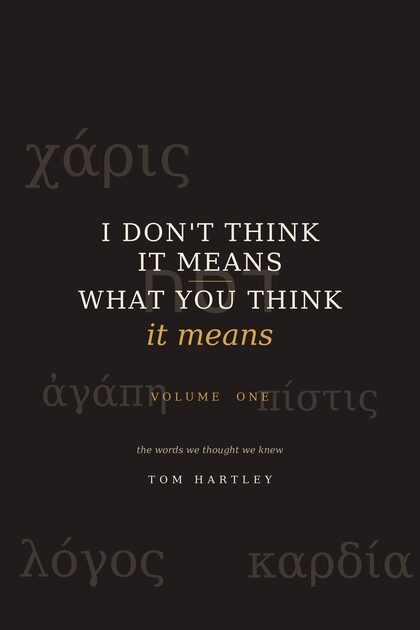
I Don’t Think It Means What You Think It Means
Volume One · The words we thought we knew