The Form Without the Fire
The Power Thereof · Part 1 of 26
“Having a form of godliness, but denying the power thereof: from such turn away.”
— 2 Timothy 3:5
“And he denied him, saying, Woman, I know him not.”
— Luke 22:57
On the night Jesus was arrested, Peter followed at a distance. They led Jesus into the high priest’s house, “And when they had kindled a fire in the midst of the hall, and were set down together, Peter sat down among them” (Luke 22:55).
A servant girl looked at him in the firelight and said he’d been with Jesus. “And he denied him, saying, Woman, I know him not” (Luke 22:57).
Twice more he was asked, and twice more he said no. Then the rooster crowed. “And the Lord turned, and looked upon Peter. And Peter remembered the word of the Lord, how he had said unto him, Before the cock crow, thou shalt deny me thrice. And Peter went out, and wept bitterly” (Luke 22:61–62).
Peter wasn’t confused about who Jesus was. He’d seen the miracles. He’d confessed Him as the Christ. He was warm by the fire, close to the action, right there in the courtyard. And he said, “I know him not.”
The word Luke uses for “denied” is arneomai. It means to deny, to say no, to disown.1 And Paul uses the very same verb in a verse most of us know well, and usually aim at somebody else.
The Verse We Aim at Other People
“Having a form of godliness, but denying the power thereof.” When that line gets quoted, it’s usually pointed at the church down the road, or the denomination we left. It’s a handy verse for describing what’s wrong with them.
But Paul didn’t write it as a weapon. He wrote it in a letter to a young pastor he loved, near the end of his own life, and he was describing something that could happen to anyone. Including Timothy. Including you and me.
So it’s worth reading it properly, with the verses that come before it.
Read the List First
Verse 5 comes at the end of a long passage that starts in verse 1. Paul says, “This know also, that in the last days perilous times shall come” (2 Timothy 3:1). Then he gives a list of what people will be like:
“For men shall be lovers of their own selves, covetous, boasters, proud, blasphemers, disobedient to parents, unthankful, unholy, Without natural affection, trucebreakers, false accusers, incontinent, fierce, despisers of those that are good, Traitors, heady, highminded, lovers of pleasures more than lovers of God” (2 Timothy 3:2–4).
Look at what’s on that list. It isn’t a list of churches that don’t pray for the sick. It’s a list of character. Selfish. Greedy. Proud. Ungrateful. Unloving. People who love their own comfort more than they love God.
And then comes verse 5. These same people have “a form of godliness.” They look the part. They know the words. They turn up. But something is missing on the inside, and Paul names it: they deny “the power thereof.”
The power of what? The Greek says tēn dynamin autēs: “its power.” In Paul’s sentence, “its” most naturally points back to godliness, the nearest noun.2 The power of godliness itself.
So the first power these people deny isn’t the power to heal a body. It’s the power that makes a person godly in the first place. The power that turns a selfish heart into a loving one, and makes the proud humble and the ungrateful thankful. They have the shape of a godly life, and they’ve said no to the only thing that could fill it.
That doesn’t take miracles off the table. Dynamis is also the word for the power that healed the sick and drove out devils. The power of God that changes a character and the power of God that heals a body are the same power. But Paul starts with character, so we should too.
The power we deny first is the power to become like Him.
Works of power come alongside it, not instead of it.
A Shape With Nothing Inside
The word Paul uses for “form” is morphōsis. It means a formation, an appearance, a semblance: the shape of something.3
A form isn’t a bad thing. A house needs a frame. Paul himself told Timothy, “Hold fast the form of sound words” (2 Timothy 1:13). You can own every rod and fly in the shop, know every knot, and talk about fishing all day, and still never catch a fish. The gear is good. It just isn’t the thing itself.
And there’s a better kind of form in the New Testament. Writing to the Galatians, Paul uses the verb from the same family: “My little children, of whom I travail in birth again until Christ be formed in you” (Galatians 4:19). Not formed around you. Formed in you.
Saying No, and Staying There
Peter’s denial was a moment of panic beside a fire. Paul’s word in 2 Timothy 3:5 is the same verb, but he uses a tense that describes a settled position: people who have said no and stayed there.4 Not a bad night. A way of life.
Paul shows Titus how that kind of denial works. Some people “profess that they know God; but in works they deny him” (Titus 1:16). Same word. Their mouths say all the right things. They deny Him with how they live.
Nobody in Paul’s list announces, “I reject the power of God.” They just live as if the power isn’t real, or isn’t needed, or isn’t for them.
Paul ends the verse with “from such turn away”, and we need to handle that carefully. A few verses earlier he told Timothy that “the servant of the Lord must not strive; but be gentle unto all men” (2 Timothy 2:24). The turning away means don’t follow them, and don’t let them shape you. It doesn’t mean hunting through the church for people to label. The first place to look is the mirror.
The Man Who Came Back From the Fire
Jesus knew Peter would deny Him, and He told Peter something before it happened: “Simon, Simon, behold, Satan hath desired to have you, that he may sift you as wheat: But I have prayed for thee, that thy faith fail not: and when thou art converted, strengthen thy brethren” (Luke 22:31–32). Not “if you come back.” When.
On resurrection morning, the young man in white at the tomb gave the women a message: “But go your way, tell his disciples and Peter that he goeth before you into Galilee” (Mark 16:7). And Peter. The one who had said “I know him not” was named on purpose.
Then came Pentecost. Some time later, at the temple gate, Peter told a man lame from birth to rise up and walk in the name of Jesus Christ of Nazareth, and he did. A crowd came running, and Peter said, “Ye men of Israel, why marvel ye at this? or why look ye so earnestly on us, as though by our own power or holiness we had made this man to walk?” (Acts 3:12).
In Greek, “power” there is dynamis, and the word the King James translates “holiness” is eusebeia, the same word translated “godliness” in 2 Timothy 3:5.5 Peter puts Paul’s two words side by side and says neither came from him. It wasn’t his power. It wasn’t his godliness. It was Jesus.
And when the council saw Peter and John, “they marvelled; and they took knowledge of them, that they had been with Jesus” (Acts 4:13). From “I know him not” to people noticing he’d been with Jesus.
The man who said “I know him not”
became the man people knew had been with Jesus.
The Fire Is Still Lit
If you’ve read this far and recognised yourself in the empty form, that isn’t a reason to despair. It’s the start of the way back.
You may have been going through the motions for a long time. The words are right, the habits are in place, but something has gone quiet inside. Maybe you can’t remember when it happened.
Peter is proof that denial doesn’t have to be the last word. The Lord who turned and looked at him in the courtyard wasn’t finished with him. He’d already prayed for him. He sent for him by name.
And Paul gave Timothy good news in the very same letter: “For God hath not given us the spirit of fear; but of power, and of love, and of a sound mind” (2 Timothy 1:7). That’s dynamis again. Power, given, not earned.
You don’t have to throw out the form. Keep praying. Keep reading. Keep turning up. Just stop saying no to what was always meant to fill it.
The form was never the enemy.
It was always waiting to be filled.
The Night the Hydrants Ran Dry
On the afternoon of 7 January 2025, fire came down into Pacific Palisades in Los Angeles. The firefighters did what firefighters do. They ran their hoses to the hydrants.
The hydrants on the hills were fed by three water tanks, about a million gallons each. With every hose in the neighbourhood drawing at once, the tanks emptied faster than the mains could fill them. The first ran dry before five that afternoon. The second went before nine. By three the next morning the third was empty, and crews were turning on hydrants that gave them nothing. (Read the story here.)
The hydrants were all still there, painted, bolted down, standing on the corners where they had always stood. Everything about them said water. There just wasn’t any.
Standing on the Corner
Nobody blamed the hydrants. They were built properly and stood in the right places. What was missing was what was supposed to flow through them.
That’s the picture behind “Having a form of godliness, but denying the power thereof” (2 Timothy 3:5). The building, the hymn book, the order of service, the grace before meals. Everything about it says power. When the fire comes, people run to the church the way those crews ran to the hydrants. What will they find when they open the valve?
Hydrants don’t fill themselves, and neither do we. The water comes from the source. “For God hath not given us the spirit of fear; but of power, and of love, and of a sound mind” (2 Timothy 1:7). Given, from Him. Ask Him to fill what He built.
The hydrants were all still standing.
What they were built to carry wasn’t.
Going Deeper
If you’re working through this with a group, or on your own with a notebook, here are some questions to take slowly.
- Read 2 Timothy 3:2–4 slowly. Which of those words do you recognise in yourself, not just in other people?
- Paul says the power being denied is “its power”, the power of godliness. How does that change the way you read 2 Timothy 3:5?
- Titus 1:16 talks about denying God “in works”. Where have what you say and how you live drifted apart?
- Peter said “I know him not”, and later the council saw that he “had been with Jesus”. What happened in between, and what does that tell you about the way back?
- The message on resurrection morning said “and Peter”. What does it mean to you that He sent for Peter by name?
A Prayer
Lord Jesus, I know the words, and I know the shape of a godly life. But You know where it has gone quiet inside me. I don’t want the form without You in it. Thank You that You didn’t give up on Peter by the fire, and that You haven’t given up on me. Where I’ve said no to Your power, I say yes now. Form Yourself in me, from the inside out. Make me loving where I’ve been selfish, humble where I’ve been proud, and thankful where I’ve grumbled. Fill what You gave me with Your life. In Jesus’ name, amen.
“A company of men having the form and seeking the power of godliness.”
– John and Charles Wesley, The Nature, Design, and General Rules of the United Societies (1743)
i-CH always
Notes
- James Strong, Exhaustive Concordance of the Bible (1890), Greek Dictionary, no. 720: “to contradict, i.e. disavow, reject”; Joseph Henry Thayer, A Greek-English Lexicon of the New Testament (1889), s.v. ἀρνέομαι. ↩
- Greek text of 2 Timothy 3:5 in the Textus Receptus (F. H. A. Scrivener, 1894) and the SBL Greek New Testament (2010). Autēs is feminine singular, matching eusebeias, “godliness”; morphōsin, “form”, is also feminine, so the reading rests on sense and word order as well as grammar. ↩
- Strong, Exhaustive Concordance, Greek Dictionary, no. 3446: “formation, i.e. (by implication), appearance (semblance...)”; Thayer, Greek-English Lexicon, s.v. μόρφωσις. ↩
- In 2 Timothy 3:5 the word is ērnēmenoi, a perfect participle, in both the Textus Receptus (Scrivener, 1894) and SBLGNT. ↩
- Strong, Exhaustive Concordance, Greek Dictionary, no. 2150: “piety... godliness, holiness”; Acts 3:12 checked in the Textus Receptus (Scrivener, 1894) and SBLGNT. ↩
The books
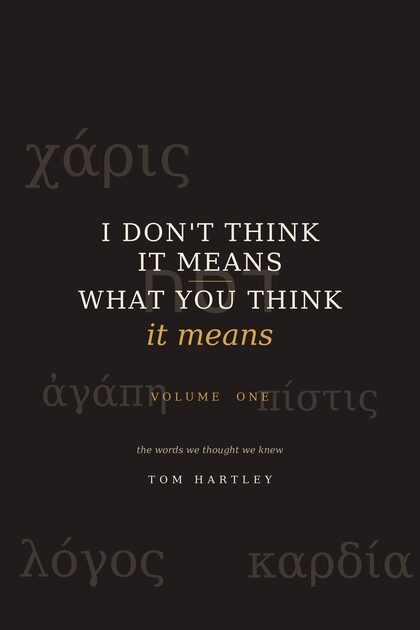
I Don’t Think It Means What You Think It Means
Volume One · The words we thought we knew